
What a 9% Targeted Annual Net Return Actually Means – And How the Evertrust Private Credit Fund Gets There
A 9% targeted annual net return paid monthly is a figure that stands out in the current Canadian income investment landscape. GICs are offering 4–5%. Corporate bond funds are yielding less. Dividend ETFs hover around 3–4%. Against this backdrop, a well-structured private mortgage fund targeting 9% net per annum deserves close examination — both in terms of how it generates that return and what risks are involved.
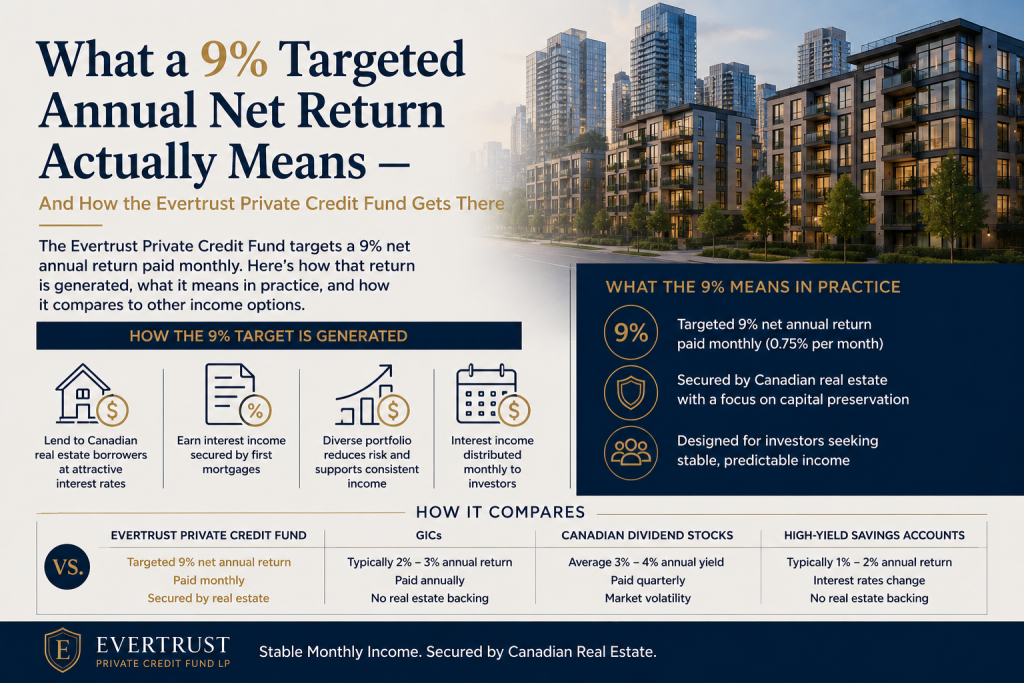
How the 9% Return Is Generated
The Evertrust Private Credit Fund LP generates income through a straightforward mechanism: it lends capital to real estate borrowers at rates that reflect the complexity and term of each loan, and the interest income earned flows to investors after fund expenses.
The fund’s average loan portfolio metrics reflect the lending rates required to support the 9% net target:
- Average interest rate on loans: 11.1%
- Average lender fee: 2.4%
- Average LTV: 68%
- Average loan term: 2.3 years
- Average loan size: $3.4 million
The gross yield generated by the portfolio — from both interest income and fees charged to borrowers, all of which flow to the fund — supports the 9% net return target after the management fee (2.0% annualized for Class A Units).
Critically, because Evertrust Capital Management structures all fee income to flow to the fund rather than to the manager, the investor benefits from the full economics of the lending relationship — not just the interest component.
Monthly Distributions: The Cash Flow Advantage
The EPCF distributes income to investors monthly. This is not a detail — it is a meaningful structural advantage for income-focused investors.
Monthly distributions allow investors to: access a regular, predictable income stream; reinvest distributions through the DRIP (Distribution Reinvestment Program) to compound returns over time; and plan their financial needs around a known monthly payment rather than waiting for quarterly or annual events.
For retirees, for corporate investment accounts seeking regular income, and for anyone using private credit as a yield-enhancement allocation within a broader portfolio, monthly distributions represent real cash flow benefit.
How Does 9% Compare to Other Income Options?
Put in context, the EPCF’s 9% targeted net return compares favourably to most conventional income alternatives available to Canadian investors:
| Product | Approximate Yield (2025) |
| 5-Year GIC | 4.0–4.5% |
| Canadian Corporate Bond Fund | 4.5–5.5% |
| Canadian Dividend ETF | 3.0–4.0% |
| REIT (publicly traded) | 4.0–6.0% |
| Evertrust Private Credit Fund (targeted) | 9.0% net |
The premium reflects the illiquidity and complexity of private mortgage lending versus publicly traded alternatives — investors in private credit funds are compensated for accessing a less liquid, less easily traded investment.
It also reflects the specific structural advantage of the EPCF: all fee income flowing to the fund rather than the manager adds meaningful basis points to the investor return that comparable funds route to management instead.
What About Risk?
A 9% targeted return in a mortgage lending context is not speculative. It reflects the actual rates at which private real estate loans are originated in Ontario — rates that are higher than bank financing because the borrowers either need speed, flexibility, or deal structures that conventional lenders won’t provide.
The risk mitigation in the EPCF comes from its underwriting approach: conservative LTV ratios (50–65% target), a preference for first mortgage positions, institutional-grade due diligence on every borrower and property, and a management team with a decade-long track record of 23 basis points per annum in loan losses on over $280 million of funded mortgages.
Losses of 23 basis points per annum on a portfolio generating 11.1% gross interest means the fund’s historical loss experience has been a fraction of a fraction of its gross yield — a meaningful indicator of underwriting discipline.
Accessing the Evertrust Private Credit Fund
The fund is available to accredited investors across Canada with a minimum subscription of $100,000. Registered account investments are available through the Evertrust Private Credit RSP Fund.
Book an appointment online: Read More
Visit: https://www.frontfundr.com/evertrust
Call: 647-501-2345 ext. 112 Email: info@evertrustdevelopments.com
Targeted returns are not guaranteed. Please review all offering documents before investing.